 Ireland
County Meath
N53 41 30.012 W6 27 0
Date of Inscription: 1993
Criteria: (i)(iii)(iv)
Property : 770 ha
Buffer zone: 2,560 ha
Ref: 659
News Links/Travelogues:
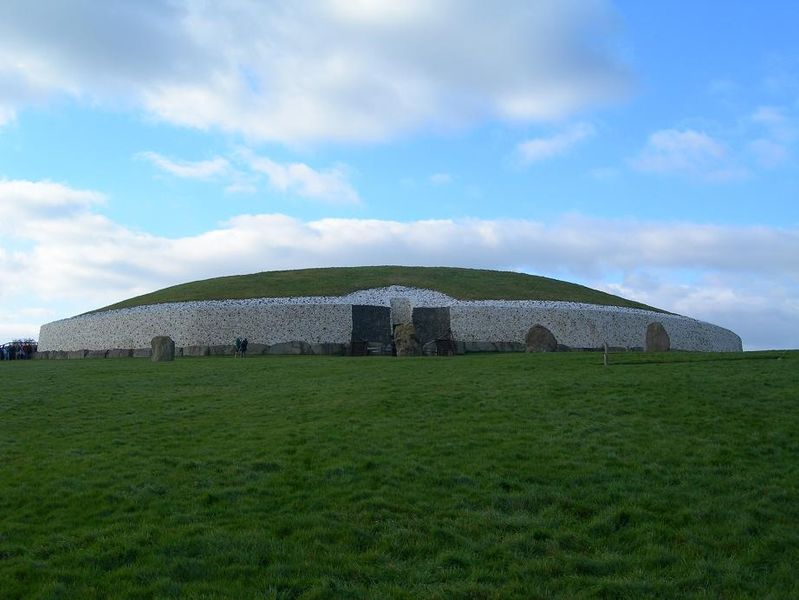
The three main prehistoric sites of the Brú na Bóinne Complex, Newgrange, Knowth and Dowth, are situated on the north bank of the River Boyne 50 km north of Dublin. This is Europe’s largest and most important concentration of prehistoric megalithic art. The monuments there had social, economic, religious and funerary functions.

Bounded on the south by a bend in the River Boyne, the prehistoric site of Brú na Bóinne is dominated by the three great burial mounds of Knowth, Newgrange and Dowth. Surrounded by about forty satellite passage graves, they constitute a funerary landscape recognised as having great ritual significance, subsequently attracting later monuments of the Iron Age, early Christian and medieval periods.
Located about 40 km north of Dublin on a ridge between the rivers Boyne and Mattock, within several kilometres of other prehistoric mounds, the site is part of an area rich in stories of Ireland’s ancient past. Predominantly agricultural at the present time the area has been extensively explored for more than a hundred years by archaeologists and historians, with excavations revealing many features.
The Knowth group, where the earliest features date from the Neolithic period and the latest from the Anglo-Norman period, has produced thirty monuments and sites that figure on the official inventory; these include passage graves adorned with petroglyphs, enclosures, occupation sites and field systems. The Newgrange group is purely prehistoric, with a ringfort, cursus, passage graves and a henge. The Dowth group is similar to that at Newgrange but there is medieval evidence in the form of a church and a castle.
Criterion (i): The Brú na Bóinne monuments represent the largest and most important expression of prehistoric megalithic plastic art in Europe.
Criterion (iii): The concentration of social, economic and funerary monuments at this important ritual centre and the long continuity from prehistory to the late medieval period make this one of the most significant archaeological sites in Europe.
Criterion (iv): The passage grave, here brought to its finest expression, was a feature of outstanding importance in prehistoric Europe and beyond.
Suggested Bases:
Dublin (Irish: Baile Átha Cliath, “Town of the Hurdled Ford”) is the capital city of Ireland. Its vibrancy, nightlife and tourist attractions are world renowned and it’s the most popular entry point for international visitors to Ireland. As a city, it is disproportionately large for the size of the country with a population of 1.9 million in the Greater Dublin Region (2011); nearly half of the Republic’s population lives in this metropolitan area. The central sights can be navigated by foot, with a few outlying sights, and suburbs sprawling out for miles. The climate is mild so Dublin is a year-round destination. It’s seldom freezing in winter, cool in summer and frequent light showers anytime, see County Dublin weather chart. There is a Dublin Visitor Centre northside at 1 Sackville Place opposite the GPO, and another southside at 118 Grafton Street by Trinity College. They’re both open daily 08:30-18:00. Several other places call themselves “tourist offices” but are just marketing their own tours [read more].
Drogheda (Irish: Droichead Átha, “Bridge of the Ford”) is a town of 41,000 people (2016) on the east coast of Ireland. It is midway between Dundalk to the north and Dublin to the south. See Newgrange (Irish: Sí an Ḃrú/Brú na Bóinne). Neolithic burial mound. A UNESCO World Heritage Site, built in the Neolithic times before the Celts had arrived on the island, Newgrange is a huge passage tomb. Older than both Stonehenge and the pyramids, it’s a World Heritage Site. The unique and advanced design of this tomb includes a lightbox that beams a shaft of light into the tomb only on the winter solstace. It is part of the Brú Na Bóinne Archaeological Park, about 5 miles (8 km) west of Droheda, local buses run out to the visitor centre. St. Peter’s Church, West Street. In the town centre contains a shrine to St. Oliver Plunkett. Relics on display there include some of his bones and, most notably, his severed head [read more].
Limerick (Luimneach) is a city in County Limerick in the Shannon Region of Ireland. It’s a miniature Dublin with its Georgian streets, historic sights, and many visitor amenities, and is a good base for visiting its surrounding county plus County Clare and County Tipperary. Limerick grew up at the limit of tides and navigation of the River Shannon. In the 9th century the Vikings first raided it then settled, calling it Hlymrekr which probably means low-lying and fertile. As elsewhere in Ireland, they were overthrown by the native Irish in the 10th / 11th C, who in turn came under the rule of the Anglo-Normans. In 1205 King John ordered the construction of the castle on the river island in the Shannon, and the English settled in this area of King’s Island, with their “Englishtown” protected by massive walls. South across the small River Abbey lay “Irishtown”, with the natives firmly put in their place [read more].
 All About World Heritage Sites

