 Italy
Italy
Province of La Spezia, Liguria Region
N44 6 24.984 E9 43 45.012
Date of Inscription: 1997
Criteria: (ii)(iv)(v)
Property : 4,689.25 ha
Ref: 826
Latest News/Travelogues:
The Ligurian coast between Cinque Terre and Portovenere is a cultural landscape of great scenic and cultural value. The layout and disposition of the small towns and the shaping of the surrounding landscape, overcoming the disadvantages of a steep, uneven terrain, encapsulate the continuous history of human settlement in this region over the past millennium.

Stretching 15 km along the eastern Ligurian coast between Levanto and La Spezia, the jagged, steep coastal landscape has over centuries been intensively developed with stone walled terraces for the growing of vines and olive trees. The area was almost inaccessible, except by sea, until the Genoa-La Spezia railway was built in the 1870s.
The property, extending from the Punta Mesco in the west and to the Punta Persico in the east, encompasses the territory of Porto Venere, the three islands of its archipelago (Palmaria, Tino and Tinetto), and the Cinque Terre, the collective name of the five villages of Monterosso, Vernazza, Corniglia, Manarola and Riomaggiore.
Some of the cultivation terraces extend to as much as 2 km in length. Terraces extended along the steep slopes from a few meters above sea level to up 400 m a.s.l., the highest altitude suitable for cultivation. They were mostly built in the 12th century, when Saracen raids from the sea had come to an end. The drystone walls are most often carefully constructed of sandstone rough blocks, bonded together with pebbles removed from the ground.
The maintenance of the terraces and the cultivation of vines and olive trees on the terraces reflect a communal approach to farming and the collaboration and cooperation of the communities without which such cultivation would not have been possible.
The natural garrigue and maquis vegetation survives intact in the higher parts of the steep ridge. The nature of the terrain and the vegetation provides food and shelter for a wide range of insect and animal species.
The local communities have adapted themselves to this seemingly rough and inhospitable environment by living in compact settlements on the coast or in small hamlets on the hillsides (e.g. Volastra, Groppo, Drignana, San Bernardino or Campiglia), erected directly on the rock with winding streets. The general use of natural stone for roofing gives these settlements a characteristic appearance. They are generally grouped around religious buildings or medieval castles. The terraces are also dotted by innumerable tiny stone huts isolated or grouped together (e.g. at Fossola, Tramonti, Monestiroli or Schiara) used for temporary shelter during the harvest.
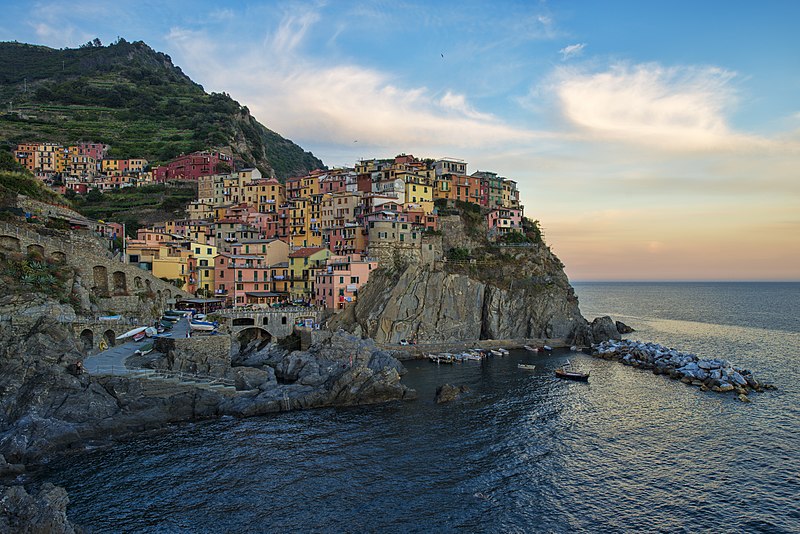
The main five villages of Cinque Terre date back to the later Middle Ages. Starting from the north-west, the first is the fortified centre of Monterosso al Mare, that is a coastal town grown along two short valleys and facing one of the few beaches that exist in the area. Vernazza has developed along the Vernazzola water-stream on the slopes of the rocky spur protecting the village from the sea. Corniglia is the only village which has not been built on the coast itself but on a high promontory projecting to the sea. Manarola is a small hamlet in which the houses are ranged in part on a rocky spur running down towards the sea and partly along the Grappa stream. The most eastern – southerly village is Riomaggiore; its houses line the narrow valley of the Rio Maggiore water-stream, today covered to be used as main street.
Portovenere was an important commercial and cultural centre dating back to the Roman period, from which archaeological remains survive in its vicinity. It is compact in form, the houses aligned along the coastline culminating in the Doria Castle, which dominates the settlement and is a historical palimpsest, with many traces of its medieval predecessor.
Off the coast at Portovenere, the three islands of Palmaria, Tino and Tinetto, noteworthy not only for their natural beauty but also for the many remains of early monastic establishments that they contain.
The rugged and visually dramatic coastal landscape, with its tall compact settlements and visually spectacular terraces that were shaped over almost a millennium, is an exceptional testimony to the way traditional communities interacted and still interact with their difficult and isolated environment to produce a sustainable livelihood.
Criterion (ii): The eastern Ligurian Riviera between Cinque Terre and Portovenere is a cultural site of outstanding value that illustrates a traditional way of life that has existed for a thousand years and continues to play an important socio-economic role in the life of the community.
Criterion (iv): The Ligurian coastal region from Cinque Terre to Portovenere is an outstanding example of landscape where the layout and disposition of small towns, historically stratified, in relation to the sea, and the shaping of the surrounding terraces that overcame the disadvantages of a steep, uneven terrain, encapsulates the continuous history of human settlement in this region over the past millennium.
Criterion (v): Portovenere, Cinque Terre, and the Islands (Palmaria, Tino and Tinetto) is a remarkable cultural landscape created by human endeavour over a millennium in a rugged and dramatic natural environment. It represents the harmonious interaction between people and nature to produce a landscape of exceptional scenic quality.
Suggested Base:
La Spezia is a town in Liguria in the northwestern region of Italy. La Spezia is one of the four provinces of Liguria and has a population of about 91,391 inhabitants. La Spezia’s inhabitants are called Spezzini. The area of this Ligurian town is of 51.4 square kilometers. It’s a beautiful city with a beautiful sea that blends with the nearby mountains. A good overlap of sky, earth and water. The streets are full of bergamot trees, and next to the beach there are really beautiful gardens with weird plants, absolutely well maintained. The train from Genoa to Pisa passes through La Spezia. The train route from La Spezia to Levanto passes through the CinqueTerre National Park. Day or multi-day train passes (~€15 per day for a family of 4 in 2007) are available allowing unlimited travel on this route. See Scola Tower. A former military building on a tiny island, later converted to a lighthouse [read more].
Genoa (Italian: Genova, Ligurian: Zena) is a historic port city in northern Italy, the capital of the Liguria region. As a tourist attraction, is often overshadowed by cities such as Rome or Venice, even though it has a long history as a rich and powerful trade centre. However, with its multitude of hidden gems behind cozy alleyways, excellent cuisine (notably fish and seafood), renovated old port, beautiful sights (including one of Europe’s biggest aquariums), and its position as the European Capital of Culture in 2004, the birthplace of explorer Christopher Columbus is an enticing place which is gradually becoming more included in the touristic market. With unusual typical slate-roofed houses, artistic churches, lovely seaside villas, and several luxurious boutiques, Genoa is a must-see if you want to experience the “quintessential” Italy. [read more]
Milan (Italian: Milano; Milanese: Milan) is financially the most important city in Italy, and home to the Borsa Italiana stock exchange. It is the second most populous city proper in the country, but sits at the centre of Italy’s largest urban and metropolitan area. While not considered as beautiful as some Italian cities, having been greatly destroyed by Second World War bomb raids, the city has rebuilt itself into a thriving cosmopolitan business capital. In essence, for a tourist, what makes Milan interesting compared to other places is that the city is truly more about the lifestyle of enjoying worldly pleasures: a paradise for shopping, football, opera, and nightlife. Milan remains the marketplace for Italian fashion – fashion aficionados, supermodels and international paparazzi descend upon the city twice a year for its spring and autumn fairs. [read more]
 All About World Heritage Sites

