 Luxembourg
Luxemburg
N49 36 36 E6 7 59.988
Date of Inscription: 1994
Criteria: (iv)
Property : 29.94 ha
Buffer zone: 108.73 ha
Ref: 699
News Links/Travelogues:
Because of its strategic position, Luxembourg was, from the 16th century until 1867, when its walls were dismantled, one of Europe’s greatest fortified sites. It was repeatedly reinforced as it passed from one great European power to another: the Holy Roman Emperors, the House of Burgundy, the Habsburgs, the French and Spanish kings, and finally the Prussians. Until their partial demolition, the fortifications were a fine example of military architecture spanning several centuries.

Brief synthesis
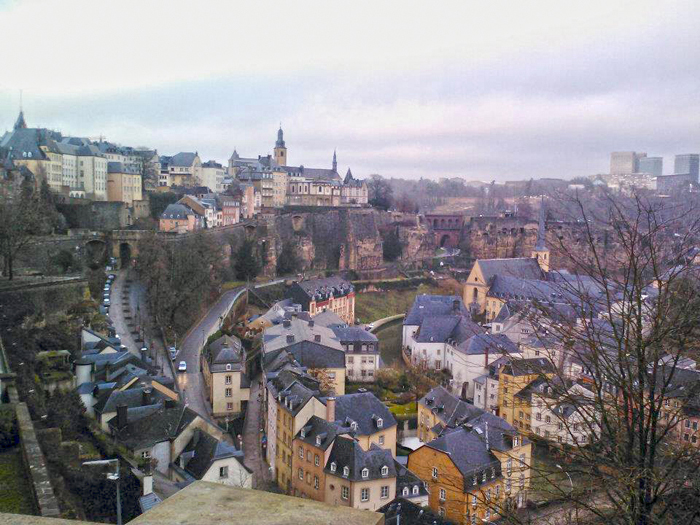
The Old City of Luxembourg is located at the confluence of the Alzette and Pétrusse Rivers, on a very steep rocky outcrop which is somewhat of a natural fortification that only needed to be completed on the west side. Due to its exceptional strategic position, the City of Luxembourg was one of the largest fortresses of modern Europe which was constantly strengthened and reinforced as it passed successively into the hands of the great European powers.
Originally, the City of Luxembourg comprised only a small fort (the castle) built shortly after the middle of the 10th century on an almost inaccessible rock. In the 12th century, the settlement that developed near the castle was protected by a stone fortification wall, which was extended in the 14th and 15th centuries. In 1443, the city was taken by the troops of Burgundy. Through inheritance it passed to the Habsburgs and became Spanish until 1684. During this period, the site was transformed into a veritable fortress. After the conquest by King Louis XIV, Vauban extended and reinforced the fortifications. In the 18th century, the Austrians continued his work and created the “Gibraltar of the North”. After the Congress of Vienna, the Prussians created new military structures until the dismantling was decided in 1867. Following the Treaty of London in 1867, the majority of the fortifications were demolished but many vestiges representative of all these eras remain, of which a number of gates, forts, bastions, redoubts and casemates.
The city also retains the layout of its streets and many public buildings, important testimony of its origins and its development since the 10th century. Inside and at the foot of the ramparts, quarters where people lived and engaged in trades or crafts developed. They also kept places of worship, such as the Church of St. Michel, now a veritable museum of sacred art, or the Church of St. Nicolas, subsequently transferred to the sanctuary of the Jesuits, the present cathedral. The ancient Abbey of Neumünster is a landmark in the borough of Grund. In the Upper Town, in the shadow of the walls, aristocratic families and the major religious communities built their mansions called “shelters” to be close to the administrations and official institutions. The old quarters still bear the imprint of their former inhabitants and their activities.
Despite the dismantling of the fortress, the fortifications and the old quarters, today the city is a historical ensemble of prime importance. It is an outstanding example of a fortified European city and host to an exceptional variety of military vestiges illustrating a long period of Western history.
Criterion (iv): The City of Luxembourg played a significant role in European history for several centuries. It preserves major remains of its impressive fortifications and its old quarters, in an exceptional natural setting.
Suggested Bases:
The city of Luxembourg is the capital of the namesake country, and with a population just above 100,000 it is the second smallest national capital of the European Union, after Malta’s Valletta. Very different in character from the bustling metropoles of the continent, Luxembourg is defined by its mountainous location and spectacular elevations afforded by the deep and narrow valley of the rivers Alzette and Petrusse it was built upon. The city has historically been an inconquerable fortress, which led it to be nicknamed the “Gibraltar of the North”. Luxembourg may not feature on most tourists’ bucket lists, but it sees a very generous share of incoming visitors every year for a city of that size. This is due to its importance in the European financial sector, with many banks and institutions having their headquarters or subsidiaries there. Moreover, as one of the founding members of the European Union, Luxembourg hosts… [read more].
The Land of the Red Rocks (French: Region Terres Rouges), also known as the Esch-sur-Alzette canton, is the furthest southwest region of Luxembourg. The Land of the Red Rocks, also known as the Esch-sur-Alzette Canton, is a former mining region in southern Luxembourg that is filled to its brim with industrial heritage. The name Land of the Red Rocks comes from the reddish iron ore that was found and extracted from the ground in high amounts. The growth the region experienced during the 1900s can still be seen in numbers: Six of the ten biggest cities and towns of Luxembourg are located in the Land of the Red Rocks. While all of the cities can easily be explored on foot, getting from one city of town to another usually takes a long time and a lot of effort. If you still want to see the best parts of the region while hopping between… [read more].
Differdange is a commune with town status in south-western Luxembourg, 17 miles (27 km) west from the country’s capital. It lies near the borders with Belgium and France and it is located in the canton of Esch-sur-Alzette. With a population of around 26,000, Differdange is the country’s third largest city. It is also the main town of the commune, and other towns within the commune include Lasauvage, Niederkorn, and Oberkorn. Differdange is an industrial town that was home to much of Luxembourg’s steel production, much of its development occurred during its heyday. Today, Differdange still remains an important industrial center, with ArcelorMittal, the world’s largest steel producer, retaining an important steel factory in the town. Notable landmarks in Differdange include the Maison de Soins de Differdange, an ancient Cistercian abbey dating back to 1235 and the Differdange Castle, located on a hill in the centre of the town, which dates from 1577… [read more].
 All About World Heritage Sites

