
 India
India
N24 52 60 E74 38 46
Date of Inscription: 2013
Criteria: (ii)(iii)
Ref: 247rev
News Link/Travelogue:
The serial site, situated in the state of Rajastahan, includes six majestic forts in Chittorgarh; Kumbhalgarh; Sawai Madhopur; Jhalawar; Jaipur, and Jaisalmer. The ecclectic architecture of the forts, some up to 20 kilometres in circumference, bears testimony to the power of the Rajput princely states that flourished in the region from the 8th to the 18th centuries. Enclosed within defensive walls are major urban centres, palaces, trading centres and other buildings including temples that often predate the fortifications within which developed an elaborate courtly culture that supported learning, music and the arts. Some of the urban centres enclosed in the fortifications have survived, as have many of the site’s temples and other sacred buildings. The forts use the natural defenses offered by the landscape: hills, deserts, rivers, and dense forests. They also feature extensive water harvesting structures, largely still in use today.
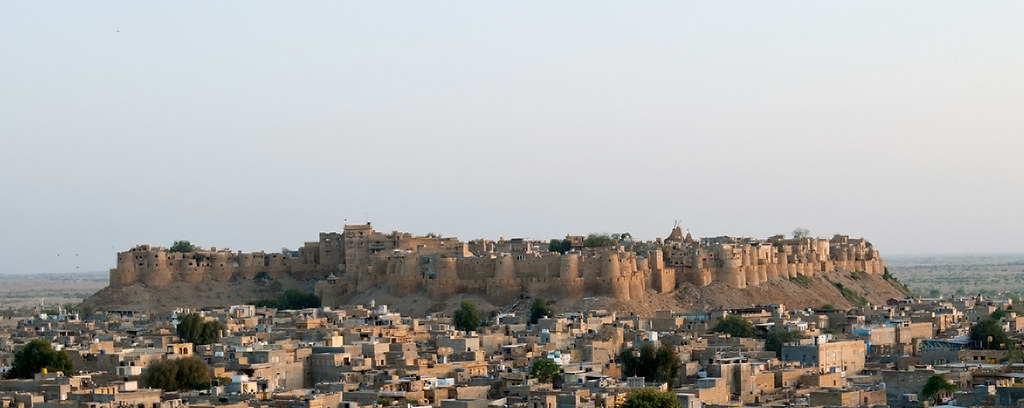
Within the State of Rajasthan, six extensive and majestic hill forts together reflect the elaborate, fortified seats of power of Rajput princely states that flourished between the 8th and 18th centuries and their relative political independence.
The extensive fortifications up to 20 kilometres in circumference optimized various kinds of hill terrain, specifically the river at Gagron, the dense forests at Ranthambore, and the desert at Jaisalmer, and exhibit an important phase in the development of an architectural typology based on established “traditional Indian principles”. The vocabulary of architectural forms and of ornaments shares much common ground with other regional styles, such as Sultanate and Mughal architecture. Rajput style was not ‘unique’, but the particular manner in which Rajput architecture was eclectic (drawing inspiration from antecedents and neighbours) together with its degree of influence over later regional styles (such as Maratha architecture) do make it distinctive.
Within the defensive walls of the forts, the architecture of palaces and other buildings reflects their role as centres of courtly culture, and places of patronage for learning arts and music. As well as housing for the court and military guard, most had extensive urban settlements within their walls, some of which have persisted to the present day. And some also had mercantile centres as the forts were centres of production and of distribution and trade that formed the basis of their wealth. Most of the forts had temples or sacred buildings, some pre-dating the fortifications and outliving the Rajput kingdoms, and many of these remarkable collections of buildings still attract followers. Collectively the forts contain extensive water harvesting structures, many of which are still in use.
As a former capital of the Sisodia clan and the target of three famous historical sieges, Chittorgarh is strongly associated with Rajput history and folk lore. Furthermore the sheer number and variety of architectural remains of early date (ranging from the 8th to the 16th centuries) mark it as an exceptional fort in its scale and monumentality comparable to very few other Indian forts. Kumbhalgarh was constructed in a single process and (apart from the palace of Fateh Singh, added later) retains its architectural coherence. Its design is attributed to an architect known by name –Mandan – who was also an author and theorist at the court of Rana Kumbha in Chittorgarh. This combination of factors is highly exceptional. Situated in the middle of forest, Ranthambore is an established example of forest hill fort and in addition, the remains of the palace of Hammir are among the oldest surviving structures of an Indian palace. Gagron is an exemplar of a river-protected fort. In addition its strategic location in a pass in the hills reflects it control of trade routes. Amber Palace is representative of a key phase (17th century) in the development of a common Rajput-Mughal court style, embodied in the buildings and gardens added to Amber by Mirza Raja Jai Singh I. Jaisalmer is an example a hill fort in desert terrain. The extensive township contained within it from the outset, still inhabited today, and the group of Jain temples, make it an important (and in some respects even unique) example of a sacred and secular (urban) fort.
Criterion (ii): The Hill Forts of Rajasthan exhibit an important interchange of Princely Rajput ideologies in fort planning, art and architecture from the early medieval to late medieval period, within the varied physiographic and cultural zones of Rajasthan. Although Rajput architecture shared much common ground with other regional styles, such as Sultanate and Mughal architecture, it was eclectic, drawing inspiration from antecedents and neighbours, and had a degree of influence over later regional styles such as Maratha architecture.
Criterion (iii): The series of six massive hill forts are architectural manifestations of Rajput valour, bravery, feudalism and cultural traditions, documented in several historic texts and paintings of the medieval and late medieval period in India. Their elaborate fortifications, built to protect not only garrisons for defence but also palatial buildings, temples, and urban centres, and their distinctive Rajput architecture, are an exceptional testimony to the cultural traditions of the ruling Rajput clans and to their patronage of religion, arts and literature in the region of Rajasthan over several centuries.
Suggested bases:
Jaipur, also known as the Pink City, is the capital of Indian state of Rajasthan and its largest city. The city was built in the eighteenth century by Sawai Jai Singh as India’s first planned city, and today it’s a major tourist attraction for both Indians and international visitors. It is a very picturesque city with splendid palaces, forts and historical monuments and belongs to the tourist Golden Triangle along with Delhi and Agra. It hosts several attractions including the City Palace, Govind Dev ji Temple, Vidhan Sabha, Birla Temple and several massive Rajput forts. It also serves as a stepping stone for those heading to the desert cities of Jodhpur and Jaisalmer. Now Jaipur is growing fast and various development projects are being undertaken by the government and private enterprises. The town planning and infrastructure development in Jaipur is quite above the mark relative to many other Indian cities. [read more]
Kota is in the Hadoti region of Rajasthan. It is located on the south-eastern side of the state. The Chambal river flows through the town, because of which the place is unlike the arid climate prevalent in the state. Moving around within the city is limited to auto-rickshaws, privately operated buses and cycle-rickshaws for short journeys. They charge anywhere from 50 Paise/Km. to ₹4/Km., but it’s advisable to fix the rates before taking a seat. Kota also has a larger three wheeler called tempo, which is by far the cheapest travel mode within the city. It is a shared vehicle with pre-fixed stops and fares, generally .50 Paise/Km. Kota does not have an airport of its own. The closest airport is at Jaipur, 240 km away. Kota is well connected to all cities/towns in Rajasthan. [read more]
Bhopal (Hindi: Bhopaal) is the capital of Madhya Pradesh, India. Bhopal is a good mix of the old and the new with a lot of old portions of Bhopal reminiscent of the Mughal influence and the new showcasing the planned development of a modern Indian city. Bhopal is the seat of the Madhya Pradesh Government and is a beautiful mid-sized city in the heart of India. It is said that Bhopal was originally called “Bhoj-pal” after Raja Bhoj, who is attributed with founding the city. It was an important part of the “Bhoj” kingdom with Ujjaini (a city close to Bhopal) being the seat of the kingdom. The city came to world attention in 1984 for the disastrous release of poisonous gases from the local Union Carbide chemical plant. [read more]
 All About World Heritage Sites
