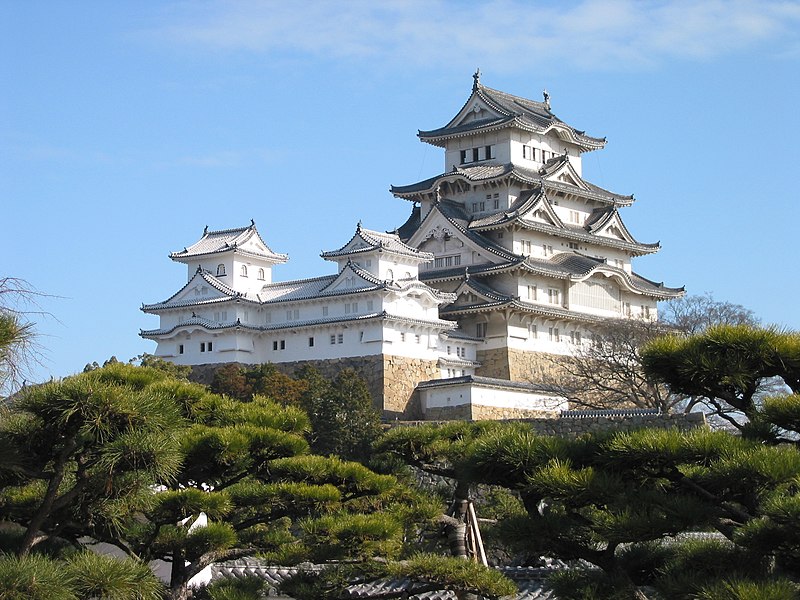

Himeji-jo is the finest surviving example of early 17th-century Japanese castle architecture, comprising 83 buildings with highly developed systems of defence and ingenious protection devices dating from the beginning of the Shogun period. It is a masterpiece of construction in wood, combining function with aesthetic appeal, both in its elegant appearance unified by the white plastered earthen walls and in the subtlety of the relationships between the building masses and the multiple roof layers.

Himeji-jo is the finest surviving example of early 17th-century Japanese castle architecture. It is located in Himeji City, in the Hyogo Prefecture, an area that has been an important transportation hub in West Japan since ancient times. The castle property, situated on a hill summit in the central part of the Harima Plain, covers 107 hectares and comprises eighty-two buildings. It is centred on the Tenshu-gun, a complex made up of the donjon, keeps and connecting structures that are part of a highly developed system of defence and ingenious protection devices dating from the beginning of the Shogun period. The castle functioned continuously as the centre of a feudal domain for almost three centuries, until 1868 when the Shogun fell and a new national government was created.
The principal complex of these structures is a masterpiece of construction in wood, combining function with aesthetic appeal, both in its elegant appearance unified by the white plastered earthen walls – that has earned it the name Shirasagi-jo (White Heron Castle) – and in the subtlety of the relationships between the building masses and the multiple roof layers visible from almost any point in the city.
Criterion (i): Himeji-jo is a masterpiece of construction in wood. It combines its effective functional role with great aesthetic appeal, both in the use of white-painted plaster and in the subtlety of the relationships between the building masses and the multiple roof layers.
Criterion (iv): It represents the culmination of Japanese castle architecture in wood, and preserves all its significant features intact.
Suggested Bases:
Kobe is a city in the Hyogo Perfecture of Japan. A cosmopolitan port city with an international flavor, hemmed in by Mt. Rokko, Kōbe is often ranked as the best place for expatriates to live in Japan. The city has a population of over 1.5 million people. A port in what would become Kōbe was established as a concession to western powers in 1868, during the time when Japan was opening to the world. Nagasaki and Yokohama had already begun serving foreign ships nine years earlier. Today, a synagogue, Japan’s first mosque, Japan’s first Sikh temple, a Chinatown, and European architecture mark Kōbe as a place where foreigners and foreign culture first arrived in Japan. Kobe’s main attraction for the Japanese is its concentration of Western-style houses, some dating back to the days when Kobe was opened for foreign trade in 1868. [read more]
Osaka is the third largest city in Japan, with a population of over 17 million people in its greater metropolitan area. It is the central metropolis of the Kansai region and the largest of the Osaka-Kobe-Kyoto trio. If Tokyo is Japan’s capital, one might call Osaka its anti-capital. Whatever you call it, though, there are many opportunities for you to discover its true anti-character. Osaka dates back to the Asuka and Nara period. Under the name Naniwa, it was the capital of Japan from 683 to 745, long before the upstarts at Kyoto took over. Even after the capital was moved elsewhere, Osaka continued to play an important role as a hub for land, sea and river-canal transportation. [read more]
Nagoya is the capital and largest city of Aichi prefecture, in the Chubu region of Honshu. The hub of the Aichi region, Nagoya is Japan’s fourth-largest city after Tokyo, Yokohama and Osaka and one of the nation’s major economic centers. In terms of manufacturing, as home to auto-making giants Toyota, Honda, Mitsubishi Motors, Nagoya is to Japan what Detroit is to the United States — which, along with having been completely flattened during World War II, also explains why it’s not one of Japan’s top tourist draws and most tourists just zip through on the bullet train on their way between Tokyo and Kyoto. But if you do decide to stick around, there are plenty of car-related attractions, a restored castle, an ancient shrine and surprisingly happening nightlife. [read more]
 All About World Heritage Sites

